Handmade Jewelry by Nao goldwork
Twenty-five years ago, I came across gold granulation products by Ilias
Lalaounis
at their store in New Otani Hotel and was amazed by their gold granulationquality.
In 1995, the online community Ganoksin was born for the jewelry industry. In this site,
I read an article explaining the granulation technique by Professor Erhard
Brepol.
https://www.ganoksin.com/article/goldsmithing-granulation-technique/
At that time, I had opportunities to visit Bali, Indonesia. In my trip,
I had a chance
to visit a store that produces and sells jewelry, especially granulated
gold products.
I found that granulation was being produced exactly as Professor Brepol
explained.
I was able to learn about the materials and production methods from the craftsmen.
After returning to Tokyo, I actually tried the learned granulation technique
myself.
Based on theses experiences, I prepared the following explanation of technique.
Currently, several training courses in gold granulation technique are being offered
around the world, and gold granulation jewelry can be viewed through image searches.
Ilias Lalaounis produces jewelry with gold granulation to order.
You can also purchase the company's past pieces at auctions.
Andrea Cagnetti, known as Akelo, has made a significant contribution,
and his works are housed in museums but can also be viewed online.
In addition to Ilias Lalaounis, companies like Zaffiro
are gaining recognition for their excellent gold granulation jewelry.
https://lalaounis.com/product/
https://www.akelo.it/en/jewelry/
https://zaffirojewelry.com/
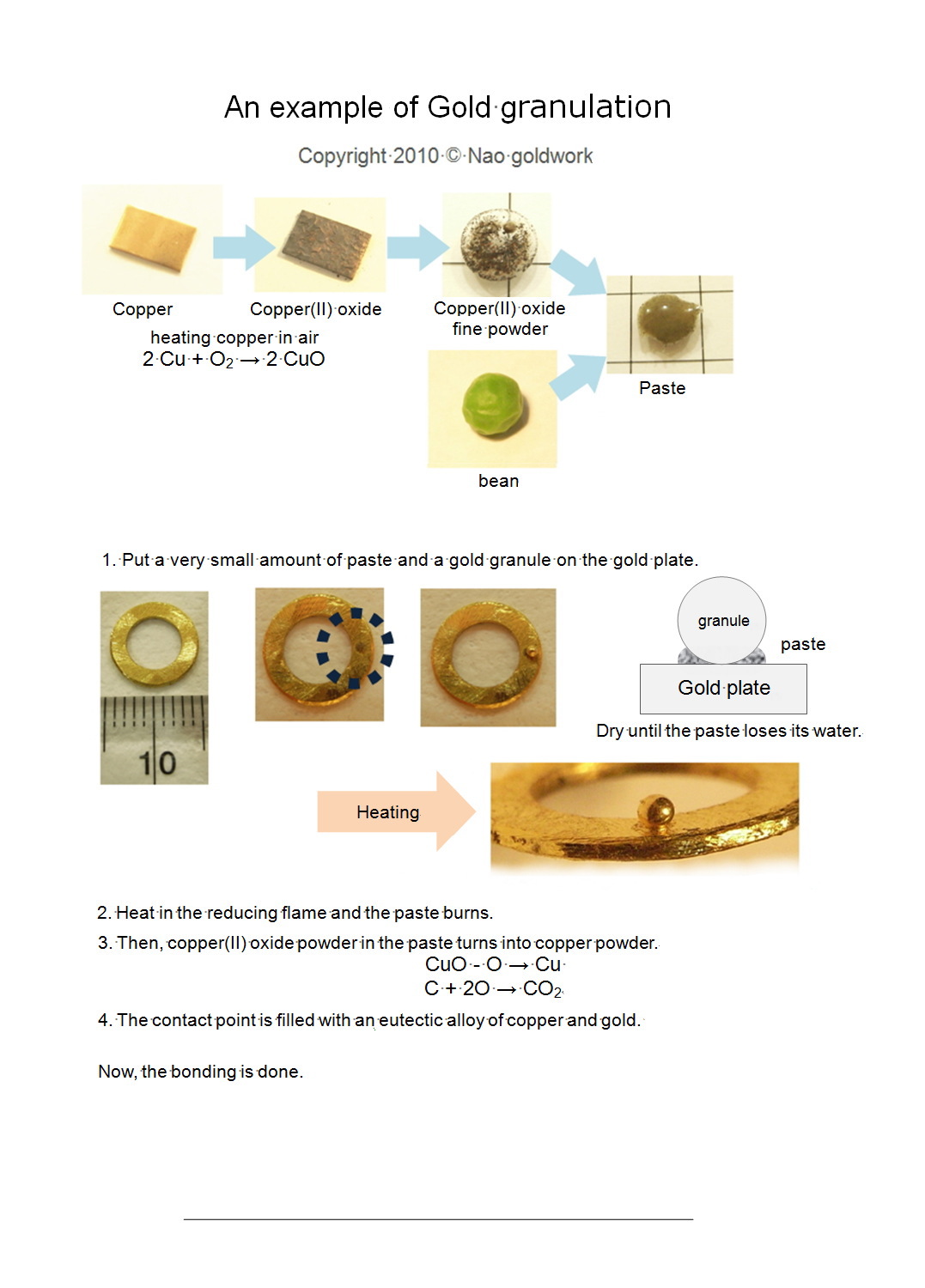
(Step 1) Molten gold is dripped and rapidly cooled. The resulting granules are sorted by size.
(Step 2) A small piece of copper is heated and oxidized. Gain oxided powder
from its surface.
(Step 3) The dried beans are ground to create a fine powder for releasing
carbon during firing.
(Step 4) Oxided copper powder and beans powder are mixed in water to create
a viscous paste.
(Step 5) The points where the gold granules will be welded are marked on the gold product.
(Step 6) A paste ball approximately 0.5 mm in diameter is applied on the
bonding point.
Put gold granules gently on the paste and leave them in a cool place for
drying.
(Step 7) Once dried, heat the product in a reducing atmosphere using charcoal
or a burner.
(Step 8) The oxided copper is transformed into liquid copper in a reducing
atmosphere.
(Step 9) Gold granules are welded to the base gold product at their contact
points.
Copyright 2025 by Nao goldwork
All rights reserved.